We ate dinner with another study abroad group and with the staff of the park. A few of the staff were really interesting and started explaining their work with the ecotourism industry, with research on howler monkeys and with environmental education programs. They also were very forgiving of my bad Spanish and were eager to help teach me new words and phrases. A few of us stayed at dinner late to keep talking with the staff and ended up making plans to play guitar and hang out later. On our walk back to the campsite, it was dusk and I glimpsed two deer through the trees!
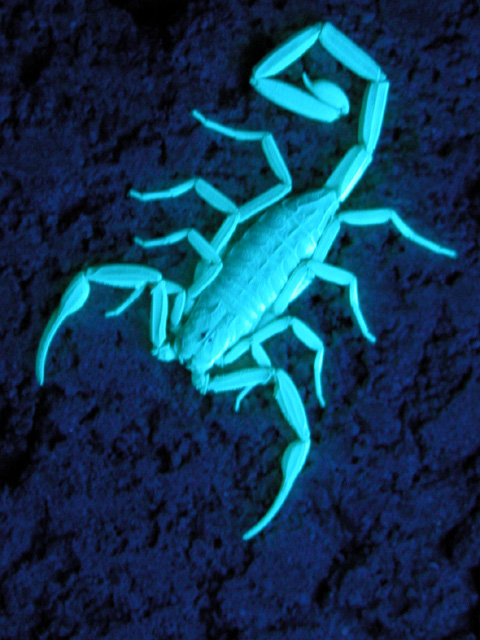
Edgardo is the ultimate wilderness badass. He took us on a night hike through the park, which was magical. Our headlamps reflected the eyes of any wildlife so the ground sparkled everywhere we looked because of the wolf spiders that were camouflaged in the leaves. When we spotted a scorpion, Edgardo had no problem grabbing it and holding it up for us to see. He explained he’d been stung so many times it doesn’t really bother him anymore. He also brought along a blacklight, which he proceeded to shine on the scorpion. It glowed! I didn’t get a picture of it, but here is an example.


The stars were incredible and even brighter than the clearest winter night back home. I didn’t recognize many of the constellations though. Soon our headlamps reflected a bigger set of eyes and Edgardo explained that it was the Common Paraque, a bird that sits on the ground and uses camouflage for protection. He nonchalantly said, “I’ll go catch it” which he did. He asked for my help by shining my light directly into its eyes while we slowly crept up on it. Because it couldn’t see, it stayed perfectly still until Edgardo was on his hands and knees directly in front of it. He lunged just as the bird took off and in a cloud of feathers, he emerged holding the bird in his hands. It was incredible. After showing it to us and explaining a bit about its physiology, he released it. Edgardo also picked up a tarantula for us to inspect, then looked surprised when we turned down his offer to hold it ourselves.
Finally, the solidifying factor that wins him the prize for coolest professor ever- he caught a gecko and explained to us that when they get frightened, they detach their tails to distract possible predators, while they run away. Soon the gecko detached its tail, which began jumping around, independently of its body. It kept twitching and jumping for about 3 minutes. After releasing the gecko, he pocketed the tail, leaving us to wonder what other interesting thing we’d find if we looked through his pockets.
The next day we got up to do our field experiment which consisted of setting up transects through the forest, starting at the road and moving further away from it. In each plot, we counted the trees, measured their DBH and height and then measured the noise from the road. This will help Edgardo in his study of the effects of the road on the forest. Later we took a hike through the park. It was really nice to not be completely drenched in sweat, for once. We saw a perfect example of an Acacia plant with the ants that live in it. This is a very interesting symbiotic relationship where the ants protect the plant (they swarm anything that tries to touch the plant…even fingers…) and the plant produces food for the ants and allows them to live inside its thorns. Here is a picture of the ants. Also a few pictures of monkeys. I couldn't help taking about a million pictures of the baby. So cute!


This is class. Jealous?


No comments:
Post a Comment